Jul 27, 2009

It appears the Swiss keep “raising the floor” on the EUR/CHF trade!

Okay, I realize that this isn’t the only pair out there. However, it is likely the ideal candidate right now as it likely has much more upside potential than downside due to the constant intervening of the SNB - Swiss National Bank (Switzerland’s central bank).

Also, keep in mind, the trend is now upward recently…and no longer downward. Being that the EUR/CHF is one of the more widely watched/traded pairs by institutions (which produce such enormous volume for a “cross pair”), it won’t be long before their automated “trend following” programs kick in and aid the central bank’s efforts.

And…it appears that the SNB keeps going into the market and selling francs “sooner and sooner” all the time. See how it continues to “raise the floor” for the EUR/CHF pair. Click on the chart to enlarge it.

intervention-continual.JPG

Sean Hyman

www.forextradingblog.com

P.S. - Want to learn more about fundamentals and technicals? Sign up for an inexpensive, only forex course today and we’ll show you how: http://www.mywealth.com/currency-trading.html

Jul 16, 2009

At the “Economic Turning Point”?

If we’re at the “economic turning point” as I believe we are…then that will be bad for the dollar, yen and Swiss franc but will be particularly good for those currencies that tend to be influenced by inflation, commodities and risk taking…which would be the Aussie dollar, New Zealand dollar, Canadian dollar and British pound…and arguably in that order.

As an additional note, if this is true…then the natural course of “Swiss franc weakness” may kick in and help the Swiss central bank out with a weaker franc. They’ve been proactively “selling francs” but there may come a time (and we could be there now) that the market actually kicks in and “aids” their intervention efforts for a weaker franc to the euro in particular. If so, between their collective “franc selling” and the market’s turning point…it could bode well for those that are long (buyers of) EUR/CHF. The Swiss are attempting to put in a floor on the EUR/CHF pair around 1.50-1.51. So anytime it gets to around the 1.51 region, one could go long the pair with a wide stop and low number of lots and probably experience a good “upside to downside” risk ratio.

I’ll also note that, so far, the Swiss have been able to reverse the daily downtrend on the EUR/CHF pair and have “held the line” quite well so far. You can look at it from most any aspect you wish and it still holds true. The pair is technically above its downtrend line, 50 SMA, 200 SMA, etc…all of which are bullish for the EUR/CHF pair. See the chart below. Click on it to enlarge it.

swiss-intervention2.JPG

Want to learn more about fundamentals and technicals? Sign up for an inexpensive, only forex course today and we’ll show you how: http://www.mywealth.com/currency-trading.html

Also, get a free, real time demo trading station here: http://www.fxedu.com/practice-forex-account

Sean Hyman

www.forextradingblog.com

bio-pic-thumbnail.jpg

Jul 10, 2009

Risk Aversion Edges Up

Over the last few weeks, the stock market rally has fizzled and commodities prices have cooled off. It’s not clear what triggered this sudden surge in introspection (I would call it reasonableness). Regardless, the markets are now wondering out loud whether the optimism of the second quarter wasn’t a bit naive.

After all, there still isn’t any evidence that global economy has turned a corner. Virtually all of the economic indicators that matter are still trending downwards. In addition, the apparent stabilization in housing prices could prove temporary, as banks move away from loan modifications and back towards foreclosure. Rumors that the Obama administration are considering a second stimulus plan are already circulating

With second quarter corporate earnings season set to kick off next week, investors are once again bracing for the worst: “Given the strong performance of stocks relative to March lows, a reality check from earnings could be detrimental to risk appetite.” Adds another analyst, “It’s renewed risk aversion, triggered by mounting doubts about a near-term economic recovery that’s evident in the sell-off on Wall Street and the subsequent decline in risk assets in general.”

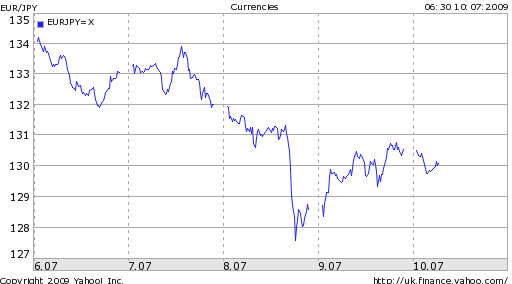
This pickup in risk aversion is also manifesting itself in forex markets, via the upturns in both the US Dollar and Japanese Yen: “The prospect of a slow and bumpy recovery remained the overriding driver of market sentiment and the dollar was soon reasserting itself as the currency of choice - apart from the yen.” Ironically, negative economic data that applies directly to the US is benefiting the Dollar, which goes a long way towards explaining the current market orientation. Currency traders have yet to turn towards comparative growth differentials (despite the predictions of some analysts) and remain firmly focused on risk. Meanwhile, “The yen rally has extended, driven by the liquidation of long-risk asset positions.” In other words, the carry trade has come under pressure as investors move back into low-risk government bonds.

euro-yenThe “uncertainty” narrative will likely continue to drive the markets for the near-term, as neither the optimists nor the pessimists have the data to support their respective positions. In all likelihood, the markets will trend sideways and safe haven currencies will see a slight inflow, until there is confirmation that the economy is firmly on the path to recovery.

Jun 30, 2009

British Pound “Pauses for Breath” [Part 1 of 2]

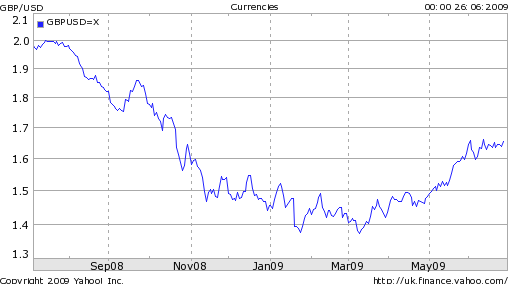
After a nearly 20% rise against the Dollar, the British Pound has been rangebound for nearly the entire month of June, with one columnist likening the situation to a “pause for breath.” For him, this amounts to a temporary cessation on the Pound’s inevitable upward path: “Compared to long term levels, the pound was still better value than its peers. He said: ‘It’s still cheap - about 10% below it’s trade-weighted average at present.’ ” For others analysts, however, the picture is not so cut-and-dried.
pound-chart

Forgetting about purchasing power parity for a minute, there are numerous factors which could halt the Pound’s rise. First and foremost is the British economy, which is still struggling to find its feet. “The U.K. economy will recover ‘mildly’ next year, according to the OECD, compared with a previous projection of a 0.2 percent contraction. Gross domestic product will drop 4.3 percent this year, versus a March forecast of 3.7 percent.”

Some economic indicators have begun to stabilize, but the two most important sectors, housing and finance, are still wobbly. Economists warn that “any recovery could be slow and uneven because banks are still unwilling to pump loans into the economy.” In the latest month for which data is available, mortgage lending slowed to a record low, with consumer lending not far behind. With regard to housing,”The annual fall in house prices in England and Wales slowed for a third consecutive month in June, according to property data company Hometrack, but prices were still 8.7 percent lower than a year ago.”

There is the possibility that the BOE’s quantitative easing plan and the government’s fiscal stimulus will provide the economy with the boost it needs. At the same time, both programs will have to be reined at some point, sooner rather than later in the case of government spending. With UK national debt predicted to reach 90% of GDP by 2010, “Most people - the prime minister excepted, apparently - believe that taxes will have to rise and/or public spending fall after the next election. This would at least threaten to hold back economic activity.” Not to mention that both QE and government spending could actually backfire and generate inflation without economic growth (i.e. stagflation). BOE Governor Mervyn King captured this overall sentiment, when he said, “I feel more uncertain now than ever. This is not the pattern of a recession coming into recovery that we’ve seen since the 1930s.”

In short, from a purely economic standpoint, it doesn’t look good for the Pound Sterling. But of course forex is about much more than GDP…stay tuned for Part 2, in which I’ll elaborate on this point, and bring interest rates and inflation into the discussion.

Jun 24, 2009

Is Risk Aversion Back?

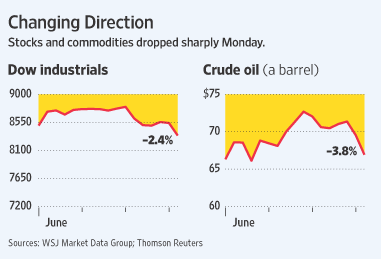
At the end of last week, I posed a question: what will be the next theme to dominate forex markets? Perhaps the answer can be found in Monday’s massive market selloff (”Triple-M Monday” anyone?), the worst day for stocks in over two months. Commodities and currencies- both of which have taken their cues from stocks of late- also trended downwards.
changing-direction
While I would be the first to caution against reading too much into one day (especially since the early indications are that some of these losses will be erased today), it’s possible that yesterday marked the breakout that many technical analysts have called for over the last few weeks. Asked one such analyst last week, “Taking a step back to look at the daily price action of the EUR/USD, we can clearly see that the currency pair is consolidating and a sharp breakout is imminent. The big question is, will it be an upside or downside breakout?”
What was the catalyst for Monday’s selloff? Perhaps it was my blog post on uncertainty: “The World Bank said Monday that prospects for the global economy remain ‘unusually uncertain,’ and it cut its 2009 growth forecasts for most economies” from 1.7% to 2.9%. But really, the World Bank was only echoing what every investor already knew- that the stock market rally rested on a house of cards, and that in fact the arguments in support of an economic recovery are still quite tenuous. In other words, “Some of the buying since early March was been based on a conclusion by many investors that government intervention had forestalled the threat of a doomsday scenario, such as another Great Depression…expectations were so low that stocks rose merely on news that indicators such as manufacturing activity or the service economy were shrinking less than had been feared. Investors didn’t require signs of actual growth.”
From trough to peak, stocks rallied 34%, pushing P/E levels back to normal levels. Now that all of the temporary pricing inefficiencies have been “corrected,” investors are taking a step back and looking to see whether the data supports further buying. Until there is solid proof that the “green shoots” are real, it’s my prediction that markets will trend either sideways or downwards.
What does this mean for forex markets? Investors will probably shun riskier currencies in favor of the Dollar and the Yen, which are still perceived as relative safe-havens. “Risk aversion has resurfaced as market participants take profits on riskier exposures. There are “renewed concerns about the extent of the ongoing global recession and the sustainability of the ‘green shoots’ of recovery,” said one analyst.
Of course, some would argue that that the emerging markets forex rally was built on a more solid foundation than US stocks. If this is the case, then perhaps the correlation between stocks and currencies will break down in the coming weeks. For now, at least, risk-averse investors will probably start to unwind carry trades and pile back into the mainstays of forex. Those with the highest interest rates will suffer the most. Until the day comes that bad economic news in the US doesn’t paradoxically buoy the Dollar, we can be certain that the current narrative is once again one of risk aversion.